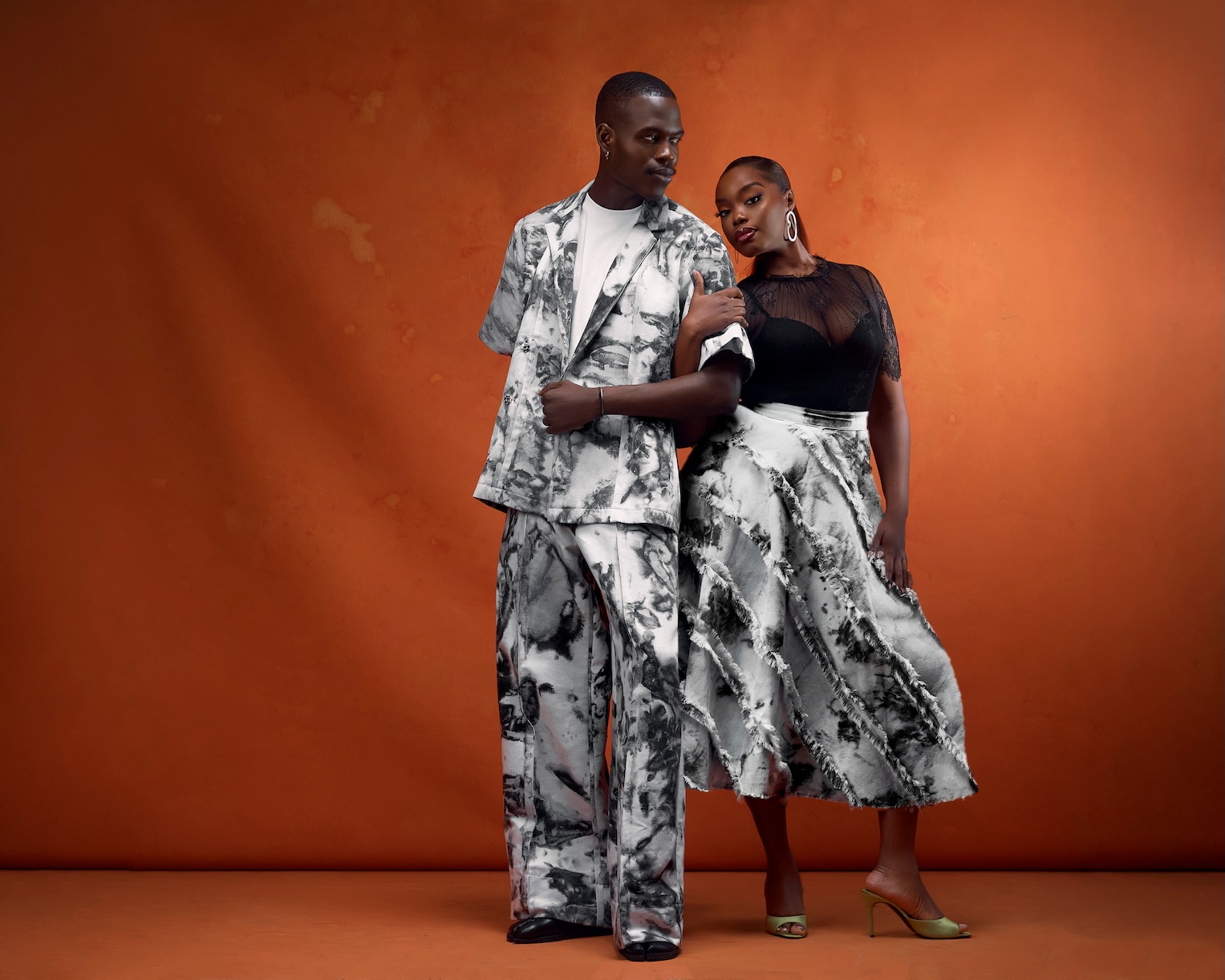
Adire is resist-dyeing on cotton. Aso-Oke is hand-woven on a loom, dense with texture and thread. I wondered what it would look like to dye Aso-Oke. Nobody I knew had tried it, but I couldn't stop wondering.
So I asked a friend of mine, a dyer, to try it on one of my own Aso-Oke fabrics. She came back a few weeks later and told me plainly: it hadn't worked out. I asked to see it.
I kept coming back to it anyway. Where she saw something that hadn't worked, I saw a jacket: the two techniques sitting on top of each other, arguing a little, and somehow still in agreement. The question wasn't whether it had failed. It was whether we were willing to let two traditions that had never touched, touch.
So we tried it on purpose. We took the resist-dyeing methods behind Adire and applied them directly onto woven Aso-Oke, letting the dye sit into a surface it was never designed for. It didn't behave the same way twice, and that unpredictability became the point.
The piece we ended up with holds both histories at once, neither one diluting the other. We called the collection Cross-Pollination, because that's what it was: not a failure corrected, but a failure followed somewhere it hadn't been asked to go.
There's a part of this process I keep tracing back to the Word. Being bold enough to try something that had never been tried only makes sense to me because I'm made in the image of a Creator who looked at everything He made and called it good.
"And God saw every thing that he had made, and, behold, it was very good. And the evening and the morning were the sixth day." Genesis 1:31
If that's true of me, it's true of what I make too.